 OnlineKhabar English News
Politics of bleeding in Nepal
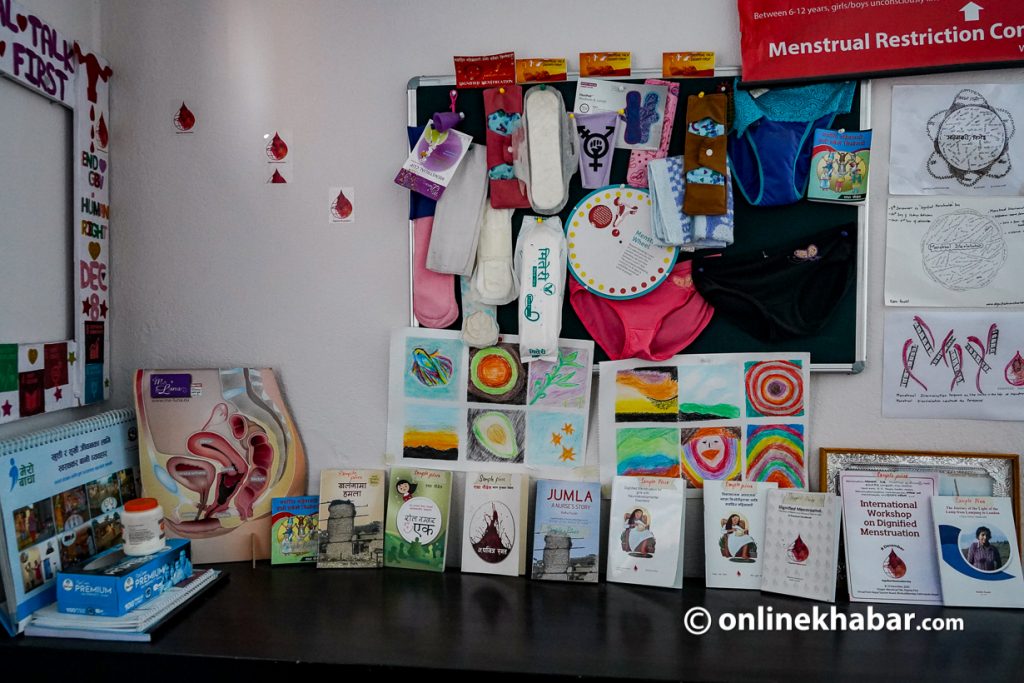
The question did not feel political when I asked it first. We were sitting in a circle at the school hall in Kalika Higher Secondary School in Turmakhand Municipality, Achham, sharing personal experiences around menstruation. When the conversation turned to menstrual health practices, I asked how many pairs of underwear they owned.
The girls began shouting two, then three, and stopped at four. Many hands were raised at two pairs, with laughter filling the air, the kind that surfaces when something private is said out loud. At three, fewer hands remained raised, and the laughter softened into smiles. At four, only one girl out of twenty lifted her hand proudly. The rest of the girls looked at her, and a heavy silence followed.
In these circles, while talking about personal experiences, hesitation appeared first. Silence followed. Then came soft laughter, lowered voices, and eventually stories that carried years of restraint. What emerged was not ignorance, but caution. Not lack of awareness, but the weight of what could not safely be said. Meanwhile, the girls understood, without saying it aloud, where they stood in relation to one another. It was not about the number of underwear they owned, but something unspoken became visible. Perhaps this understanding was not new to them, but it had never been named.
Something as basic as underwear, which I have never counted and never worried about washing in secret, revealed itself as a privilege. For many of the girls sitting in that circle, menstruation was not only about bleeding, isolation, or restriction. It was also about managing scarcity and finances. For some, it meant sharing the same cloth pads with siblings and negotiating shame within the limits of what their families could afford. To speak of menstruation, even today, is to speak of dignity, access, caste, geography, class, and the everyday inequalities that shape whose bodies are cared for and whose are disciplined.
During Travelling KIMFF 2082, nine workshops were conducted on menstruation only across the Far West, including that afternoon in Turmakhand. Over two weeks, the team travelled through Dhangadi, Kanchanpur, Dadeldhura, and Achham, screening films and holding conversations on menstruation and body autonomy. More than one hundred and fifty young girls and women, across age groups, shared stories that were different in detail but disturbingly familiar in feeling.
Films such as Sanai, Stay Away, Durga, and Eight Days, directed by Nepali women filmmakers, became entry points for conversation. Before naming their own experiences, young girls and women saw fragments of their lives reflected in someone else’s story on a big screen. After the screenings, the characters lingered with them, allowing space to reflect on customs, traditions, and what many described as fear that had never been spoken aloud in the workshops. Some schoolgirls also questioned panellists who were in positions of authority, asking how norms that have been internalised for generations can be undone. The act of questioning itself felt like a quiet rebellion.
When the Far West of Nepal is mentioned, the word ‘Chhaupadi’ often becomes the entire story. Menstrual exclusion is reduced to huts and isolation, as though it exists only in visible and extreme forms. While the criminalisation of Chhaupadi huts has led to the demolition of physical existence, fear does not disappear with their removal. It relocates itself into kitchens, prayer rooms, bedrooms, languages, and bodies. Exclusionary menstrual practices begin with biology, but they are sustained by fear. Practically, one fear belongs to society: fear of women’s bodies; Fear of blood; fear of not understanding what menstruation is and what it is not. The other fear belongs to girls and women visibly: fear of being sent to a menstrual hut or a katera; fear of snakes, cold nights, and men; fear of being judged, punished, or declared sinful for touching food, entering rooms, or resting while bleeding.
These fears are observed early, absorbed quietly, and normalised within households and communities. They are rarely discussed or introduced formally among peers, which makes silent rebellion both risky and lonely. When asked whether they had ever broken menstrual rules, no one responded at first. Later, one young girl slowly raised her hand, nodded and said that she hid her menstruation and quietly defied restrictions. Her resistance was not dramatic, but it was deliberate. The room was stunned, not because defiance was unimaginable, but because it was rarely acknowledged.
As I write this, I am bleeding. I have cramps, but I also have access to a hot water bag, warm food, clean water, and a warm room. I can decide whether to rest or travel. These choices feel ordinary until they are placed beside the lives of women and girls who sleep in cold spaces and katera and carry constant monthly fear alongside pain. Years of working in the sexual and reproductive health space have made one thing clear to me, which is that with more awareness, girls and women need safety.
In my travels, as a young woman, I feel even more deeply that we are searching for the possibility of a life where fear of punishment, exclusion, and shame is no longer inherited as tradition during menstruation. If fear had not been planted so early in our understanding of our own bodies, what might our society look like? And when we speak of menstruation in Nepal, are we willing to examine how privilege, caste, geography, class, religion, access, mobility, finances, policies, and political comfort continue to decide whose bleeding is acknowledged, whose is regulated, and whose suffering is expected to remain silent?
The post Politics of bleeding in Nepal appeared first on OnlineKhabar English News.